Showing posts with label consumer-education. Show all posts

Thursday, March 13, 2014

Just a little taste ......


To drive home the point about activating  social media I did a little Google search for "Dairy Farmers of Canada" (DFC) and came up with all of the items below on the first search page. 

 DFC was at the top ( a sponsored link) but their items were all associated with recipes and dairy goodness and links to the organization's web page.  Much too difficult for those in a hurry to find information.

Another sponsored link at the top of the page, in addition to the main link that took readers to Mr. Doyle's rebuttal article, would have given the curious (media, consumers, government) access to a balanced view.  One has to remember that it is also page views that help drive up the placement of these nasty articles.  So Mr. Doyle's Huffington rebuttal doesn't even show up. 

This strategy should be employed each and every time any of the industry's detractors put out a major report that requires rebuttal in Huffington.-CG


Conference Board slams dairy rules

Where are the farmers?


So I received information on Twitter a few days ago about this article and my first thought was "Good the industry is on top of this issue."  Then I discovered that Dairy Farmers of Canada (DFC)  was only intending to use social media.

This does not inspire me with confidence.  Especially when I  checked the article below and discovered only 67 tweets and 10 Facebook 'likes'!!  

Surely a concerted effort to involve all milk producers in a campaign to take the time to move this item along with twitter and/or Facebook would have far better results.  Anyone with a decent email list  should be able to do better than this in one county let lone the entire country.

Have all Boards done anything to encourage action from their producers? They need to be part of this and energetically share, share, share.

The goal, of course is to get this rebuttal in front of the consumer and the public.  Social media cannot do this in a vacuum. - CG


Richard Doyle

Richard Doyle

GET UPDATES FROM RICHARD DOYLE

The recent report from the Conference Board of Canada indicates a disturbing trend of think tanks offering what amounts to bad business advice.
It is not a surprise that the Conference Board calls for the dismantling of Canada's supply management system, and the fallacies and misleading assertions used to support that call are common in some circles.
One assertion, that supply management costs the average Canadian family an extra $276 per year at the grocery store for their dairy products, is based on the assumption that removing supply management would reduce the farm gate price in Canada to the so-called "world" farm gate price.
But this argument ignores the reality that farm and retail prices are not so directly linked, or that this "world price" is not what farmers elsewhere get paid all the time!
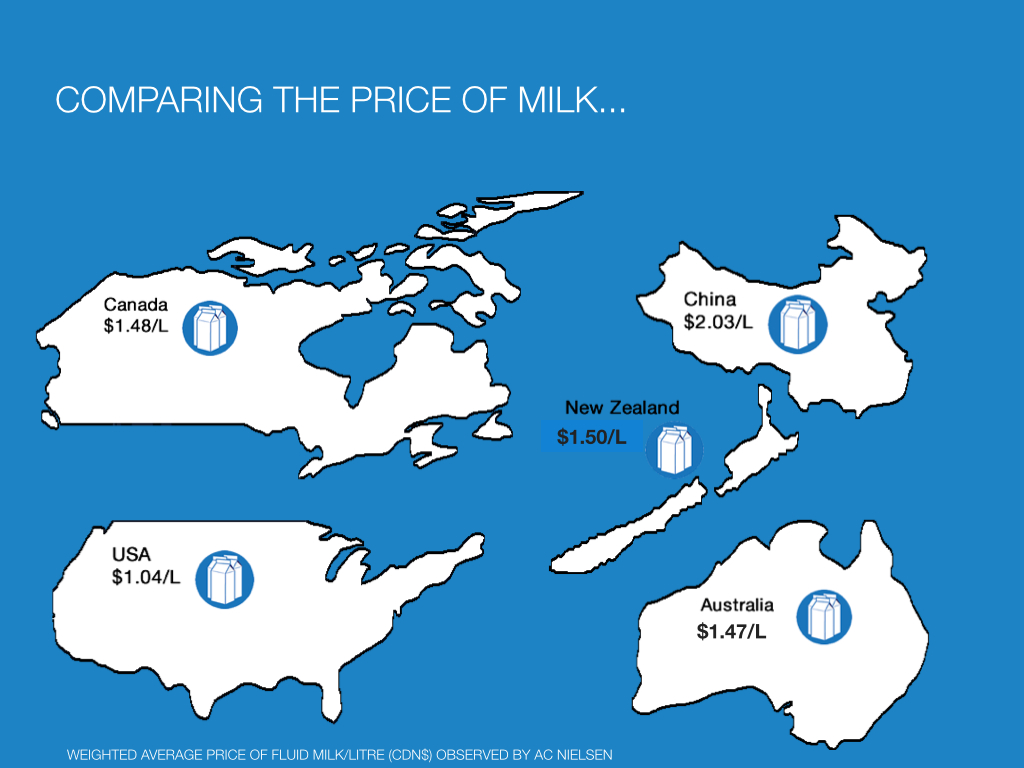
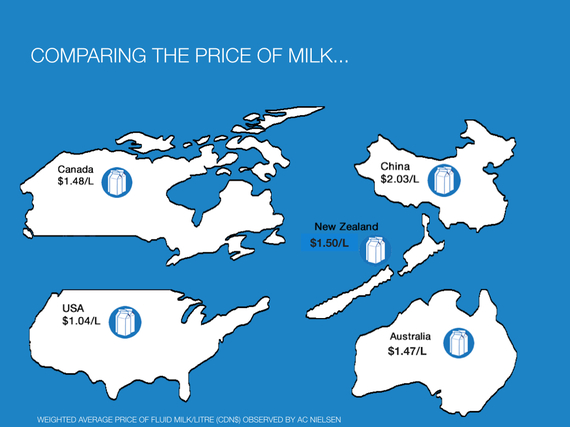
There is a better bet to compare retail prices around the world. The market research firm Nielsen has one of the most extensive resources for compiling data from millions of price points. In 2013, milk in Australia and New Zealand cost roughly the same as what we pay in Canada -- a weighted average of $1.47 to $1.50 per litre (yes there are $1/litre offerings, just like one can find that price when buying in 4-litre formats in some of the major markets in Canada).
2014-03-10-price_int.jpg

The fact is the farm is just the first link in the supply chain. There are other links between the farm gate and your refrigerator that are determining and protecting their own margins and, where they don't have supply management, they have to deal with increased pricing volatility.
It has been proven time and again around the world that deregulation in the dairy sector does not lead to lower prices for consumers. Take the Australian example, a favourite of critics of supply management.
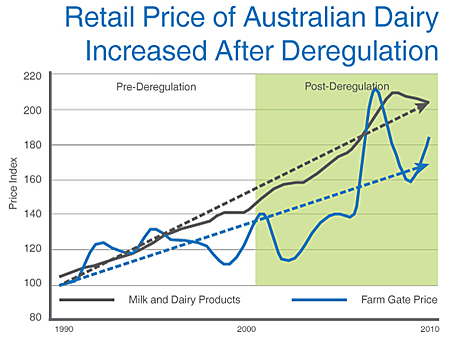
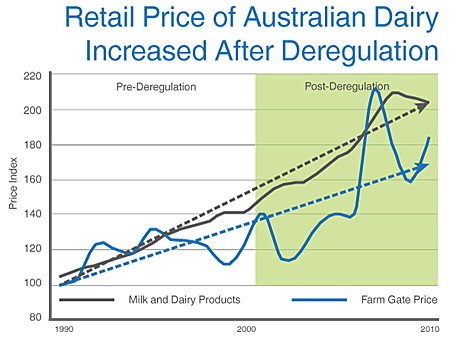
The Australian fresh milk market was deregulated in 2000, and almost immediately farm prices began to fluctuate wildly. But retail prices increased steadily, accentuated by a tax levied to help farmers with the transition. It was bad for farmers, and did not benefit consumers.
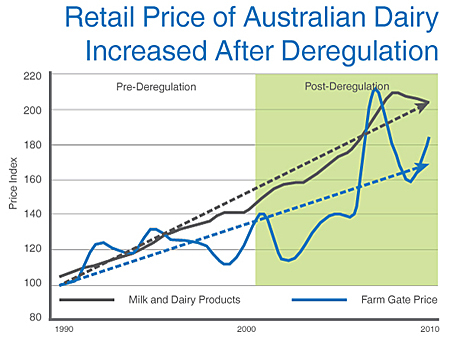
2014-03-10-myth_australianpricederegulation.jpg

In the United States, milk averages $1.04 per litre at retail. The United States experience allows us to examine the angle of the bad business advice: the average farm size is 183 cows, close to the average size the Conference Board recommends for Canada, hanging their hats on the "sales" realized by the farm, but carefully not looking at what could be the net revenue, which is important to small businesses. This 183-cow farm in the U.S lost money in 2012 -- an estimated eight cents for every litre produced, according to USDA.
It is only through a combination of government subsidies, working a second job to supplement farm income, and hopes of a better year (this year promises to be), that these farmers were able to keep going, as long as they were not too highly leveraged. To keep debts low, a small business needs to be careful in what technology they invest! It seems too easy to forget that farms, like other small businesses, need to make money to keep producing food.
European farmers know too well the harsh realities of milk prices that fall below the cost of production. Twice in recent years European farmers have taken to the streets in protest of a system that forces artificially low prices on dairy products and makes it all but impossible to eke out a living on a European livestock farm.
Recently, dairy farmers in the U.K. have protested a move by a supermarket to cut price with concern over the impact of "devaluing milk in the eyes of the consumer." Similarly,Canadian food manufacturers are pushing back on pressure from retailers over what they see as a move to cheapen their brand, and want a "code of conduct". When a business invests to build the value of their brand or product, downward pressure from distributors is not welcome. Then there are distributors taking a 30 to 50 per cent margin on a product, and letting producers be blamed for the price.
Canadians are third in the world in having the most affordable food, after U.S. and U.K. And it's safe and high quality too. While farmers don't think milk should be cheaper than water, the retail price is not set by supply management. Supply management regulates what is paid to the farmer at the farm gate for raw milk, so farmers can cover the cost of production and make a living from the farm, which operates 365 days a year.
I will conclude with an observation that, within supply management, the dairy industry has surpassed the Conference Board's most ambitious scenario in terms of new jobs creation: EcoRessources has found that jobs have increased 2.8 per cent in just two years: from 115,104 in 2009 to 118,330 in 2011.
 
Follow Richard Doyle on Twitter: www.twitter.com/@dfc_plc

Thursday, August 8, 2013

Fair Food Trade ? Not likely.

The Conference Board of Canada is at it again.  Another report and with more spurious claims.  Perhaps they think that if they acknowledge some truths their doggerel will be better accepted.

Dairy Farmers of Canada deserves some kudos from their farmers.  I hope the industry is sharing this material far and wide to their producers. Producers are increasingly finding their information and updates via Twitter and sharing it!! They in turn, can transform and impact what kind of information the media is getting by posting from Twitter.

I am amazed at how widespread items can be.  It just takes a tweet to the right place or forum. Go for guys!-CG


Richard Doyle

GET UPDATES FROM RICHARD DOYLE

One Size Does Not Fit All in Food Trade

Posted: 08/01/2013 5:22 pm

3
4
Another Conference Board of Canada report claims supply management drives up prices and discourages international trade. I found it interesting to see some trade truths being acknowledged, that one-size does not fit all. Here are some more facts:
Farmers are not against trade. Canadians want Canadian food, and coffee of course!
There is no evidence that deregulating Canada's dairy market would result in lower prices for consumers. In fact, international experience tells us otherwise.
The Australian milk industry deregulated in 2000. The experiment did not work out as people had hoped: Dairy Australia monitored farm price fluctuations increased, hurting farmers, and consumer prices just kept going up at the same pace as before, according to the Australian Bureau of Statistics, resulting in this situation: 
2013-07-31-australianpricederegulation.jpg

Neither consumers nor farmers are benefiting. In the post-deregulated Australian dairy market, price fluctuations faced by farmers are more severe, and consumers are continuing to face rising prices.
It does not seem to work in Columbia either, which I do not find surprising. I've blogged about this before.

Furthermore, supply management has not prevented Canada from negotiating significant international trade agreements. Since 1986, with supply management firmly in place, Canada has completed free trade deals with the U.S. and Mexico (NAFTA), Jordan, Columbia, Peru, Costa Rica, Chile, Israel and EFTA (Switzerland, Norway, Iceland and Liechtenstein).
It must be noted that in these negotiations, Canada was not alone in wanting to "protect" certain sectors. Beef, sugar, dairy and rice are often considered "sensitive" by several countries in trade talks, as are cars, procurement and other services. See the complete article at: One size does not fit all in Food Trade

Bruce Muirhead does it well, Again!!!

I would think that the Media would review articles like this and try to provide the public with some balance. True, it is summer and true, although farmers get upset about inaccurate press, the media does not always pay attention one way or the other.  The problem is that when they do pay attention material like that from Professor Muirhead is not at the forefront. Let's hope that by posting regular articles to the Huffington Post, they at least can find 'the other side of the story'!! -CG


Bruce Muirhead

GET UPDATES FROM BRUCE MUIRHEAD

What the Media Has Wrong About Dairy Farmers

Posted: 08/01/2013 5:21 pm

2
7
With reoccurring and recycled negative commentary about dairy supply management in the Canadian media, one would think that it, and not money, is the root of all evil. I believe that this country's media and punditry is either ill-informed on the merits of the system, or committed to a world view in which data and practical reality have no place.
The question often raised in Canada, and around the world, is this: does dairy supply management, represent a reasonable model through which to license Canadian milk production?
Neoliberal critics like Canada's Conference Board or the CD Howe Institute, and international critics like the Organization for Economic Cooperation and Development, say no, claiming the system gouges consumers, at least when compared with prices set by "the market," which in their world is rational, objective and infallible. And we have seen where that has gotten us, what with market meltdowns, imposed austerity, and sharply rising unemployment in many countries.

But more to the point, the claim is simply not true. The cost comparison between supply management and the market-determined price is like comparing apples and oranges. When the market sets the price, the direct expense to consumers does not generally reflect the outlays incurred by the farmer. As a result, government must provide billions of dollars worth of subsidies annually to farmers if they are to stay in business.
The critics of supply management do not factor these hidden taxpayer dollars into the cost of a litre of milk. In Canada that is not the case. There is no hidden subsidy provided by Canadian taxpayers to dairy farmers.
By comparison, U.S. subsidies to dairy producers represent about 40% of American dairy farmer incomes, when it reaches them. These subsidies come directly from taxpayers' pockets. Without that hidden support American dairy products would be much more costly for consumers, and much more expensive than the equivalent Canadian product.  See more at: What the Media Has Wrong about Dairy Farmers

Wednesday, July 31, 2013

Important New Dairy Industry Stats

The following article from the July Issue of the Milk Producer, is full of information that everyone who supports supply management need to have in their hands.  Certainly supply management's detractors would like everyone to ignore the facts. The figures provided below are important to farmers, governments and the public.  Use them well and spread them around.-CG


Dairy Industry Success Should Make Us Proud

DFO VICE-CHAIR’S MESSAGE By Ron Versteeg

Some people have criticized supply management as being a self-serving system that dairy farmers enjoy at the expense of others.

Nothing could be further from the truth. Canadian dairy farms produce nearly eight billion litres of milk a year, making the dairy industry Canada’s second largest agricultural sector. Our industry’s contribution to Canada’s gross domestic product has risen to $16.2 billion in 2011, up from $15.2 billion in 2009, according to ÉcoRessources Consultants, which provides economic analysis. It completed a study for Dairy Farmers of Canada on the economic impact of the Canadian dairy industry in April 2011, later updated in February 2013. The study showed the dairy industry contributes 218,330 jobs, up from 215,104 over the same time period. It is important to note this increase occurred during a difficult period in Ontario’s economy.

Our sector also pays more than $3 billion in taxes to all three government levels. This helps support several services, such as pensions, healthcare, road repair and other infrastructure projects.

All these benefits require the Canadian consumer to contribute little to maintaining our industry. Canadian consumers spend only 11.8 per cent of their disposable income on food, of which 1.07 per cent is our industry’s share of the grocery basket. Canadian per capita consumption of milk and milk products is about double the global average. By producing what the market requires, we avoid wasteful and costly surpluses. Dairy industry stakeholders enjoy reasonable costs, predictable revenues and a stable business environment. This lets producers earn a fair margin, reinvest in their farm businesses and make efficiency gains.

Our system has evolved considerably in the last four decades, yet it remains true to its guiding principles. No one has yet identified an alternative system that balances farmer, processor, government and consumer interests as well as supply management. That’s what the public interest is all about. Our long-term track record of shared success should make us all proud.


Saturday, July 27, 2013

Wow- The Globe provides Balance !!

This article was a surprise, as the Globe and Mail has not been known for its balance  around the issue of Supply Management in the past.  True, it is not written by a regular Globe reporter but they did publish it and Mr.Clarke wrote a very good, pointed article about the issue of trade and reality.  It got the usual snarky, ideological comments but still the readers of this newspaper got some balance.  It is worth the read and more. -CG


PETER CLARKE

Canadians care about their dairy supply, not Economics 101


Canada’s system of supply management for its dairy, poultry and egg sectors has been getting a lot of attention in the business press over the past few months. Ongoing trade negotiations have prompted some pundits to argue that local poultry, egg and dairy farmers stand between us and final deals.
The point of disbelief arrived when two economists from the Fraser Institute, known for promoting the power and good judgment of unfettered free markets, argued against supply management, all in the name of low income households. The C.D. Howe Institute also offered similar positions, suggesting they know better than average Canadians about what is good for them. see complete article at: Canadians Care About Their Dairy Supply not Economics 1o1-The Globe and Mail

Monday, July 1, 2013

Dairy Farmers of Canada & Huffington Post

It looks like DFC has a regular column or at least regular input into the Huffington Post.  Columns are being written by Richard Doyle -Executive Director of Dairy Farmers of Canada.  

This is  certainly one of the places to be because the Huffington Post is now often quoted as a source in the mainstream media. Who woulda thought that something that began as a fancy blog would develop into what we have today?

For those readers who do not know the Huffington Post, here is a Wikipedia account:

The Huffington Post (sometimes abbreviated Huff Post or HuffPo) is an online news aggregator and blog founded by Arianna HuffingtonKenneth LererAndrew Breitbart,[2][3] and Jonah Peretti, featuring columnists.[4] The site offers news, blogs, and original content and covers politics, business, entertainment, environment, technology, popular media, lifestyle, culture, comedy, healthy living, women's interests, and local news.

In July 2012, The Huffington Post was ranked #1 on the 15 Most Popular Political Sites list by eBizMBA Rank, which bases its list on each site's Alexa Global Traffic Rank and U.S. Traffic Rank from both Compete and Quantcast.[13]

Kudos to Dairy Farmers as their media talents and tactics come of age.  Well done.-CG


Richard Doyle

GET UPDATES FROM RICHARD DOYLE

How Should Farm Performance Be Measured?

Posted: 06/06/2013 11:35 am

3
1
0
Studies, like the recent one by the Organization for Economic Cooperation and Development, that attempt to undermine the value of supply management to Canadian agriculture must be examined carefully.
These studies compare Canada to other nations and often state that we are lagging behind. In the case of the OECD study, it claims Canadian dairy farmers have a "particularly low" economic performance. The methodology that is used for these comparators is flawed in many respects. It defines "economic performance" as a comparative to "global competitiveness," uses tools that the OECD itself has claimed to be inadequate (e.g. Producer Support Estimate calculation) and lacks consistency in the data utilized (e.g. all farms in Canada compared with only larger farms in EU).
Canadians would also find it puzzling that the OECD would not include investment by farms in modern technology as indicator of performance. Here again, dairy farms in Canada are leading the pack in investing in robotics and other technology that make farms more efficient.
In the end, it is interesting that Germany, Belgium and Australia are held up as areas where farmers are identified as performing better from an economic standpoint. But that makes one wonder why dairy farmers in Germany, Belgium and Australia have taken to the streets to protest a system based on world prices that has made it increasingly difficult for them to cover their costs?
We don't see that in Canada. Supply management not only ensures consumers can access high quality dairy products, but it also ensures efficient farmers -- not all of them! -- can receive a fair price for the milk they produce based on their costs. Read more at: the Huffington Post- How Should Farm Performance be Measured?