Showing posts with label 100% Canadian Milk. Show all posts

Thursday, March 13, 2014

Where are the farmers?


So I received information on Twitter a few days ago about this article and my first thought was "Good the industry is on top of this issue."  Then I discovered that Dairy Farmers of Canada (DFC)  was only intending to use social media.

This does not inspire me with confidence.  Especially when I  checked the article below and discovered only 67 tweets and 10 Facebook 'likes'!!  

Surely a concerted effort to involve all milk producers in a campaign to take the time to move this item along with twitter and/or Facebook would have far better results.  Anyone with a decent email list  should be able to do better than this in one county let lone the entire country.

Have all Boards done anything to encourage action from their producers? They need to be part of this and energetically share, share, share.

The goal, of course is to get this rebuttal in front of the consumer and the public.  Social media cannot do this in a vacuum. - CG


Richard Doyle

Richard Doyle

GET UPDATES FROM RICHARD DOYLE

The recent report from the Conference Board of Canada indicates a disturbing trend of think tanks offering what amounts to bad business advice.
It is not a surprise that the Conference Board calls for the dismantling of Canada's supply management system, and the fallacies and misleading assertions used to support that call are common in some circles.
One assertion, that supply management costs the average Canadian family an extra $276 per year at the grocery store for their dairy products, is based on the assumption that removing supply management would reduce the farm gate price in Canada to the so-called "world" farm gate price.
But this argument ignores the reality that farm and retail prices are not so directly linked, or that this "world price" is not what farmers elsewhere get paid all the time!
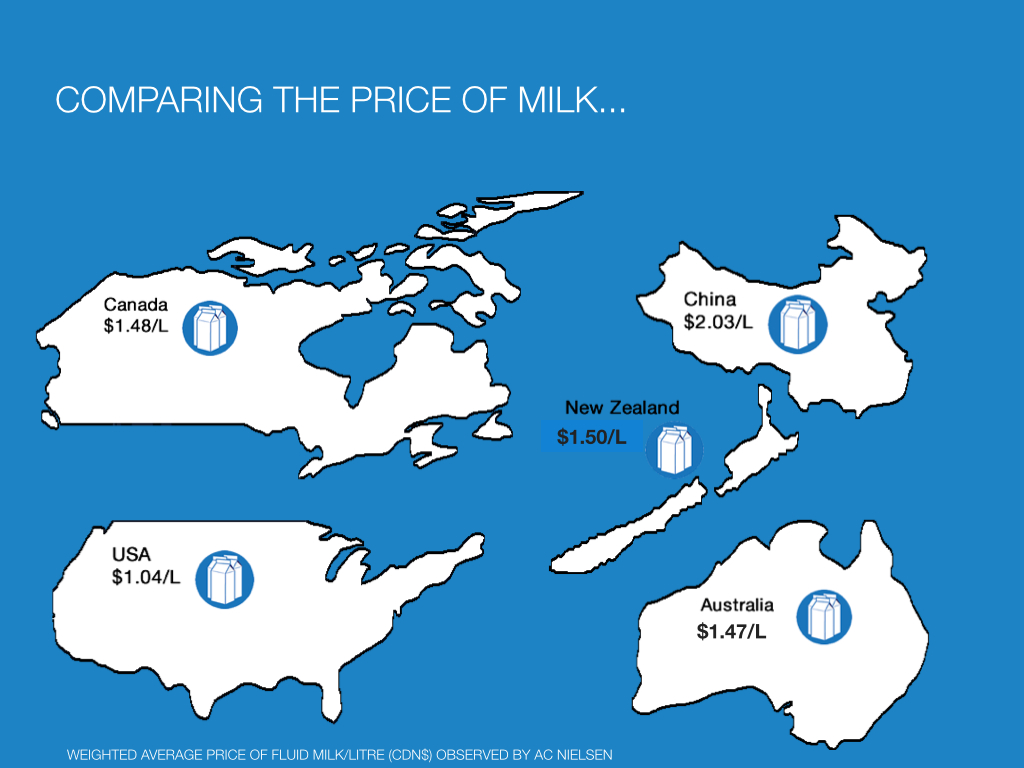
There is a better bet to compare retail prices around the world. The market research firm Nielsen has one of the most extensive resources for compiling data from millions of price points. In 2013, milk in Australia and New Zealand cost roughly the same as what we pay in Canada -- a weighted average of $1.47 to $1.50 per litre (yes there are $1/litre offerings, just like one can find that price when buying in 4-litre formats in some of the major markets in Canada).
2014-03-10-price_int.jpg

The fact is the farm is just the first link in the supply chain. There are other links between the farm gate and your refrigerator that are determining and protecting their own margins and, where they don't have supply management, they have to deal with increased pricing volatility.
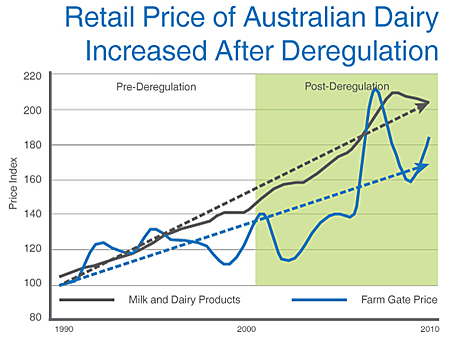
It has been proven time and again around the world that deregulation in the dairy sector does not lead to lower prices for consumers. Take the Australian example, a favourite of critics of supply management.
The Australian fresh milk market was deregulated in 2000, and almost immediately farm prices began to fluctuate wildly. But retail prices increased steadily, accentuated by a tax levied to help farmers with the transition. It was bad for farmers, and did not benefit consumers.
2014-03-10-myth_australianpricederegulation.jpg

In the United States, milk averages $1.04 per litre at retail. The United States experience allows us to examine the angle of the bad business advice: the average farm size is 183 cows, close to the average size the Conference Board recommends for Canada, hanging their hats on the "sales" realized by the farm, but carefully not looking at what could be the net revenue, which is important to small businesses. This 183-cow farm in the U.S lost money in 2012 -- an estimated eight cents for every litre produced, according to USDA.
It is only through a combination of government subsidies, working a second job to supplement farm income, and hopes of a better year (this year promises to be), that these farmers were able to keep going, as long as they were not too highly leveraged. To keep debts low, a small business needs to be careful in what technology they invest! It seems too easy to forget that farms, like other small businesses, need to make money to keep producing food.
European farmers know too well the harsh realities of milk prices that fall below the cost of production. Twice in recent years European farmers have taken to the streets in protest of a system that forces artificially low prices on dairy products and makes it all but impossible to eke out a living on a European livestock farm.
Recently, dairy farmers in the U.K. have protested a move by a supermarket to cut price with concern over the impact of "devaluing milk in the eyes of the consumer." Similarly,Canadian food manufacturers are pushing back on pressure from retailers over what they see as a move to cheapen their brand, and want a "code of conduct". When a business invests to build the value of their brand or product, downward pressure from distributors is not welcome. Then there are distributors taking a 30 to 50 per cent margin on a product, and letting producers be blamed for the price.
Canadians are third in the world in having the most affordable food, after U.S. and U.K. And it's safe and high quality too. While farmers don't think milk should be cheaper than water, the retail price is not set by supply management. Supply management regulates what is paid to the farmer at the farm gate for raw milk, so farmers can cover the cost of production and make a living from the farm, which operates 365 days a year.
I will conclude with an observation that, within supply management, the dairy industry has surpassed the Conference Board's most ambitious scenario in terms of new jobs creation: EcoRessources has found that jobs have increased 2.8 per cent in just two years: from 115,104 in 2009 to 118,330 in 2011.
 
Follow Richard Doyle on Twitter: www.twitter.com/@dfc_plc

Wednesday, July 31, 2013

Important New Dairy Industry Stats

The following article from the July Issue of the Milk Producer, is full of information that everyone who supports supply management need to have in their hands.  Certainly supply management's detractors would like everyone to ignore the facts. The figures provided below are important to farmers, governments and the public.  Use them well and spread them around.-CG


Dairy Industry Success Should Make Us Proud

DFO VICE-CHAIR’S MESSAGE By Ron Versteeg

Some people have criticized supply management as being a self-serving system that dairy farmers enjoy at the expense of others.

Nothing could be further from the truth. Canadian dairy farms produce nearly eight billion litres of milk a year, making the dairy industry Canada’s second largest agricultural sector. Our industry’s contribution to Canada’s gross domestic product has risen to $16.2 billion in 2011, up from $15.2 billion in 2009, according to ÉcoRessources Consultants, which provides economic analysis. It completed a study for Dairy Farmers of Canada on the economic impact of the Canadian dairy industry in April 2011, later updated in February 2013. The study showed the dairy industry contributes 218,330 jobs, up from 215,104 over the same time period. It is important to note this increase occurred during a difficult period in Ontario’s economy.

Our sector also pays more than $3 billion in taxes to all three government levels. This helps support several services, such as pensions, healthcare, road repair and other infrastructure projects.

All these benefits require the Canadian consumer to contribute little to maintaining our industry. Canadian consumers spend only 11.8 per cent of their disposable income on food, of which 1.07 per cent is our industry’s share of the grocery basket. Canadian per capita consumption of milk and milk products is about double the global average. By producing what the market requires, we avoid wasteful and costly surpluses. Dairy industry stakeholders enjoy reasonable costs, predictable revenues and a stable business environment. This lets producers earn a fair margin, reinvest in their farm businesses and make efficiency gains.

Our system has evolved considerably in the last four decades, yet it remains true to its guiding principles. No one has yet identified an alternative system that balances farmer, processor, government and consumer interests as well as supply management. That’s what the public interest is all about. Our long-term track record of shared success should make us all proud.


Thursday, July 25, 2013

EU Trade Deal & Public Hearings?


This article was flashing around parts of the internet the other day. It sure is important to have our Premier's focus on this issue.  It is also important that dairy organizations ensure their premiers and their Ministers are kept in this particular information loop. 
It becomes even more important when they are reminded that Ottawa has continued its downloading to the Provinces, removal of supply management would directly impact the provinces and local economies, so provincial jurisdiction, control and input becomes enormously important in the lobbying battle to protect supply management. If you tweet and saw this article I hope you passed it on.-CG

Prime Minister Stephen Harper gives the thumbs up as he arrives on stage following his majority win in Calgary, Alta, Monday, May 2, 2011. The Harper government has made a successful Comprehensive Economic and Trade Agreement with 28 European Union nations a key economic and political goal – it would constitute the only major free trade deal since NAFTA two decades ago. (ADRIAN WYLD/THE CANADIAN PRESS)

OTTAWA

Critics urge provinces to hold public hearings on EU trade deals

Published Sunday, Jul. 21, 2013 06:52PM EDT
Last updated Monday, Jul. 22, 2013 04:48AM EDT
Critics of the free trade talks with Europe are urging provinces to ensure any negotiated deal gets a full public airing before it is formally signed.

The Trade Justice Network and Quebec-based Le Reseau quebecois sur l’integration continentale has sent premiers a letter in advance of their meeting in Niagara-on-the-Lake, Ont., next week, saying the federal review mechanism is not sufficient.

The umbrella groups, which represent unions and civil society organizations, say provinces must step in because “the current federal government has rejected virtually every amendment proposed by opposition parties to every trade agreement that has come before Parliament for review.”
The Harper government has made a successful Comprehensive Economic and Trade Agreement with 28 European Union nations a key economic and political goal – it would constitute the only major free trade deal since NAFTA two decades ago.

Unlike trade talks of the past, however, Canadian provinces have had to be directly involved in the process since some of the biggest issues – such as liberalized government procurement and public hydro-electricity tenders – fall under provincial jurisdiction.

As well, expected extensions in pharmaceutical patent protections will likely result in higher provincial health care costs. With so much involved, the groups say the provinces must hold public hearings, adding there is precedent for doing so.

“If there is a difference between the CETA and these other trade and investment agreements it is surely that the Canada–EU agreement will have far greater impacts on provincial sovereignty, as well as on policy flexibility at all levels, including municipally,” the letter notes.
“We therefore urge your government, and the Council of the Federation, to champion the idea of a democratic review of the CETA in between conclusion of the negotiations and a formal signing of the agreement.”

Most analysts believe a deal could be signed in principle this fall, despite several missed deadlines.
Officials on both sides of the Atlantic contend only a few difficult issues remain to be resolved, including expanded access for Canadian beef exports and European demands that Canada allow more imports of European dairy products.

But analysts also warn momentum could be stalled if the talks are not concluded quickly, particularly as the European Union is refocusing its attention on a deal with the more lucrative market in the United States.

Ottawa has maintained a deal could boost Canada’s economy by $12-billion and create about 80,000 jobs, although critics say the benefits are exaggerated.

Monday, July 1, 2013

Dairy Farmers of Canada & Huffington Post

It looks like DFC has a regular column or at least regular input into the Huffington Post.  Columns are being written by Richard Doyle -Executive Director of Dairy Farmers of Canada.  

This is  certainly one of the places to be because the Huffington Post is now often quoted as a source in the mainstream media. Who woulda thought that something that began as a fancy blog would develop into what we have today?

For those readers who do not know the Huffington Post, here is a Wikipedia account:

The Huffington Post (sometimes abbreviated Huff Post or HuffPo) is an online news aggregator and blog founded by Arianna Huffington, Kenneth Lerer, Andrew Breitbart,[2][3] and Jonah Peretti, featuring columnists.[4] The site offers news, blogs, and original content and covers politics, business, entertainment, environment, technology, popular media, lifestyle, culture, comedy, healthy living, women's interests, and local news.

In July 2012, The Huffington Post was ranked #1 on the 15 Most Popular Political Sites list by eBizMBA Rank, which bases its list on each site's Alexa Global Traffic Rank and U.S. Traffic Rank from both Compete and Quantcast.[13]

Kudos to Dairy Farmers as their media talents and tactics come of age.  Well done.-CG


Richard Doyle

GET UPDATES FROM RICHARD DOYLE

How Should Farm Performance Be Measured?

Posted: 06/06/2013 11:35 am

3
1
0
Studies, like the recent one by the Organization for Economic Cooperation and Development, that attempt to undermine the value of supply management to Canadian agriculture must be examined carefully.
These studies compare Canada to other nations and often state that we are lagging behind. In the case of the OECD study, it claims Canadian dairy farmers have a "particularly low" economic performance. The methodology that is used for these comparators is flawed in many respects. It defines "economic performance" as a comparative to "global competitiveness," uses tools that the OECD itself has claimed to be inadequate (e.g. Producer Support Estimate calculation) and lacks consistency in the data utilized (e.g. all farms in Canada compared with only larger farms in EU).
Canadians would also find it puzzling that the OECD would not include investment by farms in modern technology as indicator of performance. Here again, dairy farms in Canada are leading the pack in investing in robotics and other technology that make farms more efficient.
In the end, it is interesting that Germany, Belgium and Australia are held up as areas where farmers are identified as performing better from an economic standpoint. But that makes one wonder why dairy farmers in Germany, Belgium and Australia have taken to the streets to protest a system based on world prices that has made it increasingly difficult for them to cover their costs?
We don't see that in Canada. Supply management not only ensures consumers can access high quality dairy products, but it also ensures efficient farmers -- not all of them! -- can receive a fair price for the milk they produce based on their costs. Read more at: the Huffington Post- How Should Farm Performance be Measured? 

Thursday, March 28, 2013

100 Good Reasons


I have decided I should post some of the 100 Good Reasons to look for the 100% Canadian Milk Symbol. They need to be even more visible to the public.  Share these if you can.-CG

Canadian dairy farmers follow strict regulations on the use of antibiotics


Canadian Dairy farmers work closely with veterinarians to ensure their cattle stay healthy. 


Unfortunately, just like humans, cows sometimes get sick, and when they do, they may  need  medications such as antibiotics.

When a cow needs antibiotics, the dairy farmer has to follow strict protocols. 

While the farmer continues to milk the cow, all of her milk is collected separately and discarded for a mandatory withdrawal period until her system is clear.

On the rare occasion that a load of milk does not meet the regulatory requirements
 when it arrives  at the processing plant, the entire load is rejected and disposed of. 

Since milk samples are collected at each farm, a farmer who supplies substandard milk
 is easily identified and held accountable.

Penalties for supplying milk containing contaminants such as antibiotic residues are severe, 
so dairy farmers take great care in making sure their milk is in its purest form.

For more good reasons to share : www.100goodreasons.ca